
Back to Water Damage Restoration

Services

Burst pipes, frozen pipes and appliance leaks

Supply lines, water heaters, washing machines and condensate leaks, dried to a measured standard.

5.0 from 168 Google reviews 24 hours, by appointment

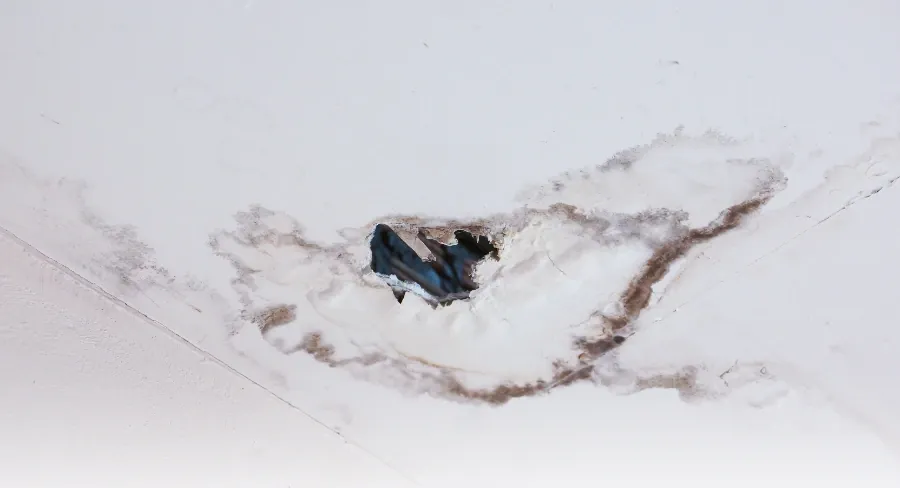
A brown water stain spreading across a white ceiling around a hole where the board gave way.

reference photograph, not one of our jobs

Photo pending

Sheet 01F, Water Damage Restoration

Scope

What this covers

A supply line failure is the best case a water loss offers, and it does not stay that way for long. Clean water from a pressurized line is category 1, which means most of what it touched can be dried in place if it is reached quickly. The two things that change the answer are the hours it ran and whether it ran through a floor into the rooms below.

  • Extraction from every level the water reached, starting with the lowest
  • Category assessed on the source and the hours, because clean water does not stay clean
  • Wall and ceiling cavities opened where a line failed inside an assembly
  • Wet insulation removed, because saturated insulation holds water and does not recover
  • Drying of framing, subfloor and finishes back to a measured dry standard
  • Photographs of the failure point and the affected material for the carrier file

Detail

Where supply line water goes

A pressurized line puts out more water in an hour than most homeowners expect, and gravity decides where it ends up.

The failure point is rarely where the damage is. Water follows the framing, runs along the top of a bottom plate until it finds a gap, drops into the joist bay and comes through the ceiling below at whatever the low point happens to be. That is why the meter is run through the whole path rather than only where the water is visible, and why ceilings below a failure are read even when they look clean.

Burst Pipe, Frozen Pipe and Appliance Leak Damage Drawn from the standard. This is a drawing and no reading on it is live. Tide line

Drawn from the standard. This is a drawing and no reading on it is live. A burst supply line is category 1 clean water, and the category rises the longer it sits.

At the failure
The cavity around the split line, the insulation in it and the framing either side.
Along the level
The floor covering and subfloor, spreading outward from the wall the line was in.
Through the floor
The joist bay, the insulation in it and the ceiling below, wet from above.
Down the wall
The wall cavity the water ran down, wet on the inside face where nothing shows.
At the bottom
The lowest floor, where the water pools and sits longest before anyone finds it.

Common questions

What people want to know before booking

What do I do first?

Shut the water off at the main. On a pressurized supply line every minute is measurable in gallons, and the shut off is worth more than anything else you can do in the first ten minutes. Then photograph the rooms before anything moves, and stay clear of standing water near outlets, cords and the panel.

Is this covered by insurance?

Sudden and accidental water damage from inside the building is covered by most standard homeowner policies, and a burst supply line is the textbook example. A slow leak that ran for months and was never addressed is usually excluded as maintenance. The loss is documented either way, so you have a complete file to give your insurer.

Do you fix the pipe?

No. Plumbing repair is a licensed trade and it is not performed here. The source has to be stopped before drying starts, because a building still taking on water cannot be dried, so the usual order is plumber first and restoration immediately behind.

The water ran downstairs. What does that change?

It multiplies the affected area. Water that goes through a floor wets the ceiling below, the insulation in the joist bay, the wall cavities it runs down and the floor at the bottom, and each of those is read separately. A single burst line on a second floor is regularly a three level drying job.

The method

Burst and frozen supply lines

A pipe bursts because water expanded in it or because the pipe failed at a joint, a fitting or a corroded section. The freeze case is the North Jersey winter case, and the pipes that freeze are the ones in unheated space: an exterior wall cavity, a crawl space, an unheated garage, an attic run and any line feeding an outside faucet that was not drained.

The damage from a frozen pipe usually happens on the thaw rather than during the freeze, which is why a house found cold and quiet can flood an hour after the heat comes back on. If pipes are frozen and have not yet burst, shutting the main before thawing them is the move that keeps a repair from becoming a restoration job.

Water from a supply line is category 1 at the moment it leaves the pipe. It stays category 1 for a short time and then it does not, because it picks up what it runs across and because a warm building degrades it. The assessment is made from the hours as much as from the source, which is the reason the first question on the call is when it started rather than what broke.

Water heaters, washing machines and dishwashers

Appliance failures split into two kinds and they are treated differently. A water heater or a supply hose that let go on the clean side is category 1 water, and it usually behaves like a burst pipe, with the extra problem that a water heater holds a full tank and releases all of it at once into whatever room it sits in.

A discharge failure is category 2. A washing machine drain hose that came out of the standpipe, a dishwasher that overflowed and a condensate pump that backed up are all gray water, which means what is in the water matters and the porous material it soaked usually comes out rather than being dried. That distinction is the difference between a pad that stays and a pad that goes.

The two most common preventable failures in this group are rubber washing machine supply hoses that were never replaced and a water heater past its service life sitting on a finished floor with no pan and no drain. Both are worth checking, and both are on the prevention checklist rather than being anything a restoration company can help with after the fact.

Air conditioning condensate leaks

An air handler pulls moisture out of the air and that water has to go somewhere. The condensate drain line carries it away, and when the line blocks with biological growth, the pan rusts through or the pump fails, the water backs up and comes out of the bottom of the unit. Because it is a slow leak from a machine that runs unattended, it is usually found late.

Two things make condensate leaks worse than their volume suggests. The water is not clean: it has been sitting in a pan and a line where growth is normal, which puts it at category 2. And the leak is often in an attic or a closet above a finished ceiling, so the first sign is a stain on the ceiling below and by then the insulation in the ceiling has been wet for days.

The work is the same as any category 2 loss reached late: the affected ceiling and insulation come out rather than being dried, the cavity is cleaned, and the framing is dried to a measured standard. The blockage itself is an HVAC repair, and the annual habit that prevents most of these is having the drain line cleared before the cooling season, not after the ceiling stains.

What is covered and what reads as maintenance

The line most carriers draw is between sudden and accidental damage and long term seepage. A pipe that burst last night is sudden. A fitting that has wept behind a wall for eight months and rotted the framing is usually treated as maintenance and excluded, whatever the water eventually did.

That has a practical consequence at the moment of discovery. Photograph the failure point itself before it is repaired, because the plumber's repair removes the evidence of what failed and how. Photograph the wet material before anything is torn out. Keep the piece of pipe or the failed hose if a plumber replaces it.

The file is written the same way regardless of how the carrier eventually decides: photographs from before anything moved, a category and class assignment, a moisture map, a daily reading log and an inventory of what was removed and why, so you have a complete file to give your insurer. We do not file, adjust or negotiate the claim.

Before you call

Frequently asked questions

Question 1: How much water comes out of a burst pipe?

Far more than people expect, because a supply line is pressurized and does not stop until the main is closed. That is why the shut off matters more than anything else in the first ten minutes, and why a line that failed while a house was empty for a weekend is usually a whole floor rather than a single room.

Question 2: My pipes are frozen but nothing has burst. What now?

Shut the main off before you thaw them. A frozen line often has a split that is being held closed by the ice in it, and the flood starts when the ice melts. With the main closed, a failure becomes a repair rather than a restoration job. Thaw gently with warm air and never with an open flame.

Question 3: Do I need drying if the leak was small and I mopped it up?

It depends on what the water reached, and a meter answers it in a few minutes. Water that stayed on a tile surface and was wiped up is finished. Water that went under a cabinet toe kick, along a wall base or under a plank floor is still there, and the visible surface is the last place a leak shows itself.

Question 4: Is an air conditioning leak an emergency?

It is not an emergency in the sense that a burst line is, and it should still be dealt with in days rather than weeks. The water is category 2, it is usually in a ceiling or an attic, and the material it has soaked has generally been wet long enough that the removal decision is already made by the time it is found.

Question 5: Which pipes freeze first in a North Jersey house?

The ones with no heat around them: lines in an exterior wall cavity, in a crawl space, in an unheated garage or attic, and any run feeding an outside faucet that was not drained and shut off in the fall. Keeping a cabinet door open under a sink on an outside wall during a hard freeze is a small habit that prevents a large number of these.

Customer reviews

5.0 from 168 Google reviews, opens in a new tab
“I called for advice on a water issue. The technician was helpful, answered all my questions, and even offered to assist further if needed. I'll definitely recommend them to anyone seeking honest and reliable help.”
Juan Kingston · · 5 stars on Google,

“Excellent job with the mold remediation in our building basement storage & conference room. They completed the work quickly after discovering mold on the wall. Their work was thoroughly done and their pricing was very fair.”

Maria Edmond · ·

“Jose was absolutely amazing. From the moment he called for an estimate to the moment he left. Very professional and did an outstanding job. Both my sofa and rug look brand new. Definitely recommend!”

Luis Guillen · ·

Read them all on Google, opens in a new tab

Coverage

Where we do this

We cover six counties across North and Central New Jersey. All services are performed at your home or business.

Towns we cover

Estimate request

Tell us what needs cleaning

Tell us the rooms, the surfaces and the address, and attach a photograph of the affected area if you have one. You receive a written estimate before any work begins, with no obligation.

Written estimate, no obligation Answered any hour at (908) 520-8698 5.0 from 168 Google reviews EPA-registered products, safe for pets and children

Written estimate

NO. 0168
A written estimate before any work begins, with no obligation.
Please enter your name.
Enter a 10 digit phone number.
Enter a valid email, or leave it empty.
Enter the street address.
Enter the town.
Enter the 5 digit ZIP.
What needs cleaning? (pick at least one)
Pick at least one surface.
Photographs of the area (optional, up to 5, 8 MB each)

A photograph of the area helps us give an accurate estimate.

    The estimate is free and there is no obligation.

    NORTH JERSEY · N.J. ESTIMATE · IN WRITING RECEIVED NO. 0168

    Request received.

    Your written estimate comes back from the technicians who do the work. For anything urgent, call (908) 520-8698.

    Get my estimate