Back to Mold Remediation

Services

Mold removal in North and Central New Jersey

Colonized material out under containment, then a written clearance result.

5.0 from 168 Google reviews 24 hours, by appointment

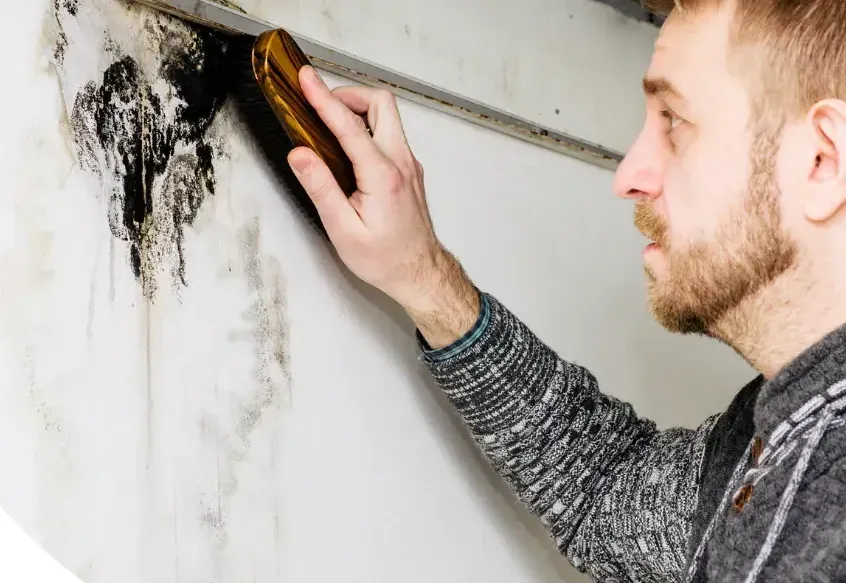
A man scraping black mold off a white wall with a hand scraper, working close to the surface.

reference photograph, not one of our jobs

Mold removal

Sheet 02B, Mold Remediation

Scope

What this covers

Mold removal is the part of the job where colonized material physically comes out. It runs under containment with negative air and HEPA filtration, and it closes with the cavity dried to a standard and a written clearance result in your hands.

  • Containment of the work area with negative air pressure while material is removed
  • HEPA air scrubbing for the whole of the removal
  • Cutting out colonized porous material back to a sound edge
  • HEPA vacuuming and damp wiping of framing and other surfaces that stay
  • EPA registered antimicrobial treatment of the cavity where the scope calls for it
  • Drying to a dry standard, then a written clearance result

Detail

What comes out and what stays

Material is sorted by how far growth can travel into it, not by how bad it looks on the surface.

Mold Removal Drawn from the standard. This is a drawing and no reading on it is live.

Drawn from the standard. This is a drawing and no reading on it is live. Porous material holds growth inside its structure, which is why it is cut out rather than cleaned.

Porous
Drywall, insulation, carpet pad, ceiling tile and particle board. Colonized pieces come out.
Semi porous
Framing and unfinished wood. Usually cleaned and dried, then read again before anything is closed.
Non porous
Concrete, metal, tile and glass. HEPA vacuumed and damp wiped.
Category three water
Porous material exposed to sewage or flood water is removed under the S500 rule, whether or not growth has appeared yet.

Common questions

What people want to know before booking

How much of the wall comes out?

Enough to get past the colonized material to a sound edge, which the inspection establishes before the estimate is written. Cutting to a fixed height because it is tidy is the wrong answer when the growth runs past it, and cutting further than the growth goes is money spent on drywall.

Will the rest of the house be affected?

That is what the containment is for. The barrier and the negative air machine hold the work area under lower pressure than the rooms around it, so air moves in rather than out while the material is disturbed, and the machine filters what it pulls through.

Do you treat the cavity afterwards?

Where the scope calls for it, with EPA registered products that are safe around pets and children. Treatment follows removal and drying and does not stand in for either.

Who closes the wall back up?

The same team. Removal leaves an open cavity and the reconstruction closes it with drywall, paint and finishing, priced as its own scope so it stays clear which part was the mitigation and which part was the rebuild.

The method

Mold removal and mold remediation, and where removal sits in the job

Removal sits between an inspection that found the water and a drying phase that ends the work. On its own it is a demolition, and a demolition in a wet cavity is a mold job that comes back.

So the order is fixed. The source is identified and stopped or scheduled to be stopped, the containment goes up, the material comes out, what stays is cleaned, the space is dried to a standard and the result is written down.

Where a plumber or a roofer has to make the repair that stops the water, that work is named before the removal begins so the sequence is not broken by a wall that is closed too early.

Setting up before anything is cut

The work area is sealed and put under negative air, and HEPA air scrubbing runs for the duration. The barrier is there because cutting colonized drywall out of a cavity releases far more into the air than growth sitting undisturbed on a wall, which is why S520 makes containment part of structural remediation.

Contents that can be moved come out first. Soft goods that were in the affected area are treated or listed for the estimate rather than put back into a room that is about to be opened up.

Where the heating and cooling system serves the room, it is shut down or isolated before the first cut so it does not carry the work to the rest of the house.

How far the cut goes

Colonized porous material is cut back to a sound edge. The boundary is decided by what the meter and the inspection found rather than by a standard height, because water travels up a wall and along a plate line without asking what looks neat.

Insulation in an affected cavity comes out with the drywall. Wet insulation holds growth inside it, and once it is compressed and wet it cannot be dried in place with any confidence.

The cut is photographed before it is closed. That photograph, with the moisture reading in the same frame, is what an adjuster reads later and what the customer keeps.

Cleaning what stays, and why bleach is not the tool

Framing, concrete, tile and metal are HEPA vacuumed and damp wiped. The vacuum takes the particles off the surface and the wipe takes what the vacuum left, and both happen before any product goes on.

The EPA does not recommend using a biocide such as chlorine bleach as a routine practice during mold cleanup. On a porous material it wets the surface without reaching the growth inside it, and wetting a cavity is the opposite of what the rest of the job is doing.

The products used here are EPA registered and safe around pets and children. They go on a cleaned and drying surface; applied over debris, a product treats the debris and not the wood.

The cavity, the drying and the readings

An open cavity dries far faster than a closed one, which is why the drying equipment goes in while the wall is still open. Air movers and dehumidifiers are placed to move air across the wet material, not around the room.

Moisture is read at set points each day until the material is back to a dry standard, and the readings are kept with the job. S500 expects that documentation at each monitoring point on each day the project is active, and it is what tells everybody the wall can be closed.

Nothing is closed on a number that is still falling. A cavity shut while the reading is still dropping is a wall that gets opened again.

The written clearance result

The removal closes with a written clearance result: what was removed, what was cleaned, the readings at the end, and confirmation that the area was checked before it was closed.

Where a sale, a landlord, a management company or a carrier needs a third party number, ask for an independent laboratory clearance as well, booked in your own name so the result does not come from the company that did the removal.

Keep the document with the reconstruction paperwork. Together they are the documentation a buyer's inspector will ask for, and they are far easier to hand over than to rebuild from memory.

When removal is not the answer

Settled spores and fragments from a source nearby, condition 2 under S520, are usually cleaned and verified without demolition. Cutting a wall open in that situation costs the customer a rebuild for no gain.

Removal also waits when the water has not been stopped. Taking out wet material while the leak is still running produces an open cavity that gets wet again, and the estimate says so instead of starting work that will have to be repeated.

Where the affected patch is under about ten square feet and the source is already fixed, the EPA guidance is that a homeowner can in most cases handle it, and that is the answer given on the phone.

Before you call

Frequently asked questions

Question 1: Why is drywall cut out instead of cleaned?

Because growth gets inside porous material instead of sitting on top of it, and there is no reliable way to clean the inside of a sheet of drywall in place. Non porous surfaces such as framing, concrete and tile are cleaned and kept.

Question 2: Do you use bleach?

No, not as a routine part of mold cleanup, which is also the EPA position. Bleach wets a porous surface without reaching the growth inside it, and adding water to a cavity works against the drying the rest of the job depends on.

Question 3: Is the removal contained?

Yes. The work area is sealed and held under negative air with HEPA filtration running, because cutting material out releases far more into the air than the growth was releasing on its own.

Question 4: Do you rebuild the wall afterwards?

Yes, as a separate scope. The removal leaves an open cavity and the reconstruction closes it with drywall, paint and finishing, priced on its own so the mitigation and the rebuild stay legible on the estimate.

Question 5: What do I get at the end?

A written clearance result listing what was removed, what was cleaned and the final moisture readings. Where a sale, a landlord or a carrier needs a third party number, ask for an independent laboratory clearance on top of that.

Customer reviews

5.0 from 168 Google reviews, opens in a new tab
“DHL did a fantastic job restoring our home after water damage. They were efficient, communicative, and the results are amazing. Thank you!”
Yohnny Cambero · · 5 stars on Google,

“Water damage is stressful, but DHL made the restoration process smooth and easy. Fast, reliable, and professional service. Highly recommend!”

Veronica Hernandez · ·

“I called for advice on a water issue. The technician was helpful, answered all my questions, and even offered to assist further if needed. I'll definitely recommend them to anyone seeking honest and reliable help.”

Juan Kingston · ·

Read them all on Google, opens in a new tab

Estimate request

Tell us what needs cleaning

Tell us the rooms, the surfaces and the address, and attach a photograph of the affected area if you have one. You receive a written estimate before any work begins, with no obligation.

Written estimate, no obligation Answered any hour at (908) 520-8698 5.0 from 168 Google reviews EPA-registered products, safe for pets and children

Written estimate

NO. 0168
A written estimate before any work begins, with no obligation.
Please enter your name.
Enter a 10 digit phone number.
Enter a valid email, or leave it empty.
Enter the street address.
Enter the town.
Enter the 5 digit ZIP.
What needs cleaning? (pick at least one)
Pick at least one surface.
Photographs of the area (optional, up to 5, 8 MB each)

A photograph of the area helps us give an accurate estimate.

    The estimate is free and there is no obligation.

    NORTH JERSEY · N.J. ESTIMATE · IN WRITING RECEIVED NO. 0168

    Request received.

    Your written estimate comes back from the technicians who do the work. For anything urgent, call (908) 520-8698.

    Get my estimate