
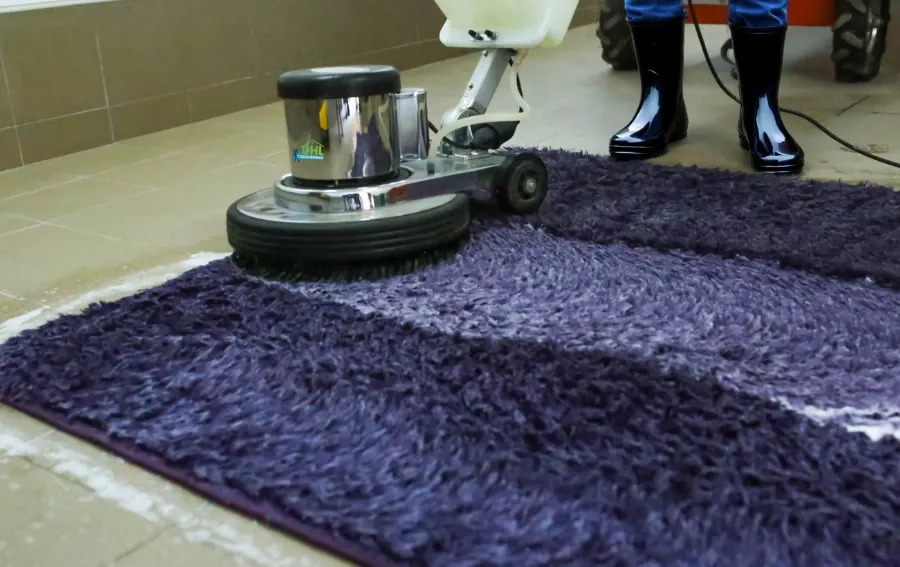
Dry soil comes out before any water goes in
A residential wool rug can hold well over a pound of dry soil per square yard before it starts to look dirty, and almost all of it sits down in the foundation where a vacuum cannot reach. Dusting uses vibration and moving air to drive that particulate back out of the weave. It removes the most allergen of any stage, and it has to come first: water introduced into a rug that has not been dusted turns dry soil into mud and binds it to the fibers.
How wool and silk behave in a wash
Wool is hygroscopic, which means it takes moisture out of the air and gives it back. In a humid North Jersey summer a wool rug holds more water than it looks like it is holding, and soil trapped in the foundation becomes food for the bacteria that produce the odor. Silk carries the same natural dyes and bleeds the same way, so the fiber and the dyes are tested before the wash is chosen.
Rinsing until the water runs clear
After the wash the rug is rinsed repeatedly until the water coming out of it is clear. Detergent left in the foundation causes rapid resoiling and can irritate a sensitive occupant. Multiple rinses matter more on a rug than on carpet, because a rug foundation holds the residue where nobody can see it.
Drying flat, and never in the sun
Controlled drying happens flat or over a pole with airflow across the rug. Direct sun fades the exposed side within a single season and sets creases into a damp foundation. A wool rug goes back down only when it is dry through, because a rug put back damp holds that moisture against the floor underneath it.
A rug that has been through a flood
A wet rug on a wet floor keeps both of them wet. Natural dyes in wool and silk bleed while they stay saturated, and color migration that starts as a wet corner can become permanent across the field inside twenty four to forty eight hours. A rug that met contaminated water is dusted, treated with an appropriate antimicrobial, then fully immersed and rinsed until clear.
Fringe, foundation and the repairs a wash cannot do
Fringe wicks soil out of the body of the rug and usually needs its own attention. A cotton foundation that stayed wet can develop dry rot, which shows as brittleness along a fold and needs a repair. Both are identified at the estimate, so no rug is washed on the assumption that washing fixes a structural problem.
The floor and the pad while the rug is up
Clean the floor under a rug while the rug is out, because the grit that lives there is the grit that gets ground back into the pile. A quality felt and rubber pad protects the foundation, and a crumbling foam pad can adhere to a floor finish and do more damage than it prevents.
Rotation, sun and wear
Turn each rug one hundred and eighty degrees each season, because a room wears a rug unevenly and turning it evens out both the fading and the traffic. Vacuum both sides while it is up, and look at the back for foundation wear, loose ends and pet damage.
Storing a wool rug
A rug going into storage must be professionally cleaned and completely dry first. Moths and carpet beetles are drawn to the soil, food residue and protein in a dirty rug, not to clean wool, so a rug put away soiled is the one that comes out damaged. Roll it pile side in around a tube and keep it off a concrete floor.
Collection, return and the written estimate
Collection and return covers Passaic, Essex, Hudson, Union, Bergen and Morris counties, so nothing has to be carried anywhere. The technicians are IICRC certified and the products are EPA registered and described as safe around pets and children.