Back to Water Damage Restoration

Services

Wet carpet and pad drying

The category and the hours decide whether the carpet is dried in place or lifted.

5.0 from 168 Google reviews 24 hours, by appointment

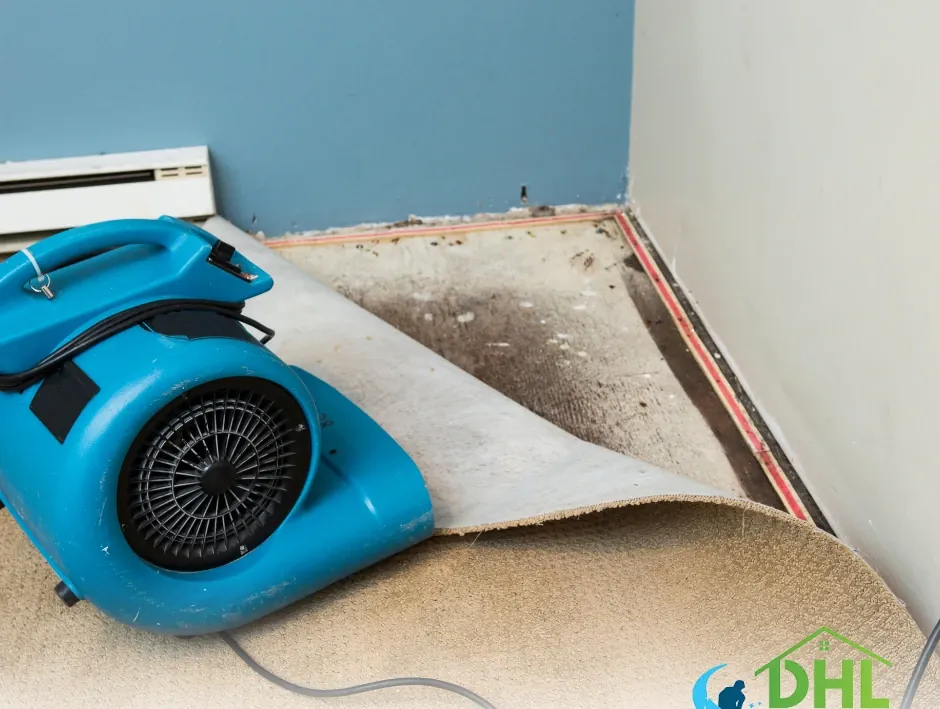
A blue air mover blowing under a carpet folded back off the tack strip, with the pad gone and the subfloor showing.

reference photograph, not one of our jobs

Photo pending

Sheet 01D, Water Damage Restoration

Scope

What this covers

Every homeowner asks the same question. The carpet is saved or lost by the category of the water and the number of hours it sat, not by how good the carpet is or how well it is extracted. This page explains the rule so you can work out where you probably stand before anyone arrives, and what changes the answer.

  • Water category assessed before the carpet is touched, because the category decides the outcome
  • Weighted extraction through the carpet face to pull water from the carpet and pad together
  • In place drying with the carpet floated and air forced underneath where the category allows it
  • Pad removal and disposal where the category or the readings require it
  • Carpet cleaned and sanitized after drying, with the method matched to the fiber
  • Re installation, re stretching and seam repair where the carpet survives the loss

Detail

The category rule for a wet carpet

Three outcomes, and the water decides which one applies before anybody looks at the carpet itself.

The S500 position is category driven. Materials affected by category 1 water can usually be dried in place. Carpet pad and drywall affected by category 2 typically come out. In a category 3 loss all porous materials the water touched are removed and discarded, including the carpet, the pad and porous subfloor. In place drying is a legitimate technique with written limits, and those limits are what stop a saved carpet from becoming a mold problem.

Wet Carpet and Pad Drying Drawn from the standard. This is a drawing and no reading on it is live. Tide line

Drawn from the standard. This is a drawing and no reading on it is live. Materials wet by category 1 water can usually be dried in place. Category 3 means the carpet and pad come out.

Category 1, clean water
Carpet and pad usually dried in place, floated with air forced underneath.
Pad still comes out where readings flatten or where the water sat too long.
Category 2, gray water
Pad removed and discarded. Carpet extracted, dried, cleaned and sanitized.
Wet drywall above the water line usually comes out with the pad.
Category 3, black water
Carpet, pad and porous subfloor removed and discarded. The structure is cleaned before it is dried.

Common questions

What people want to know before booking

Can my carpet be saved?

Clean water reached quickly is usually dried in place, carpet and pad together. Gray water usually means the pad comes out and the carpet is dried and sanitized. Category 3 water means the carpet, the pad and porous subfloor material come out. Nobody can give you the answer on the phone, because the category and the hours are established on site.

Why does the pad matter so much?

Carpet pad is open cell foam that holds several times its weight in water and holds whatever is in the water with it. Drying a contaminated pad leaves the contamination inside it. That is why the pad, not the carpet, is usually the piece that decides whether the floor is dried in place or lifted.

How long does a wet carpet take to dry?

Until it reads at the dry standard, which is a meter reading rather than a set number of days. A clean water carpet floated with air underneath and adequate dehumidification comes back first. The subfloor underneath it takes longer, particularly a plywood or a concrete subfloor, and the floor is not put back down until both read at the dry standard.

Will it smell afterwards?

A carpet dried properly and cleaned does not hold an odor. A carpet closed up over a wet pad or a wet subfloor does, and the smell that appears a week later is usually growth under the floor rather than in the fiber. That is a drying failure and it is the failure this whole process exists to avoid.

The method

In place drying, and where it stops working

In place drying means the carpet stays down and the water is taken out through it. The carpet is extracted with a weighted tool that presses the carpet and pad against the subfloor, then floated at one edge so air can be forced into the space between the carpet and the pad, with dehumidification holding the room dry enough to accept what comes off.

It works, and it has conditions. The water has to be category 1 or a category 2 loss caught in the first hours. The pad has to release water under extraction instead of staying saturated. The subfloor has to be reachable. And the readings have to keep moving, because the point of in place drying is a dry floor rather than a floor that was not lifted.

Where any of those fail, the carpet comes up. A pad that will not release is a pad that stays wet under a carpet that reads dry on top, which is exactly the condition a musty smell comes from weeks after the room looks dry.

What happens to the carpet itself

Carpet face fiber is resilient. Nylon, polyester and olefin all survive being soaked, and wool survives it too although wool holds far more water and takes longer to give it up. The face fiber is rarely the problem.

The backing is the problem. Most residential carpet is made of a face fabric bonded to a secondary backing with latex adhesive, and prolonged saturation breaks that bond. The result is delamination: the backing separates, the carpet loses its dimensional stability and it ripples permanently when it is re stretched. Delamination is checked for before a carpet is committed to drying, because a delaminated carpet dried for four days is four days spent on a carpet that has to be replaced anyway.

Seams are the other weak point. A soaked seam tape lets go, and a carpet that has been lifted and floated needs its seams checked and re done before it is re stretched. Where the carpet survives, it is cleaned after drying with the method matched to the fiber, and re stretched properly rather than pushed back into the grippers.

What is under the carpet matters as much

A wooden subfloor takes water into the top layers of plywood or board and holds it. It usually dries, and it takes longer than the carpet above it, which is the reason a floor is not closed up on the day the carpet reads dry. A particle board underlayment is different: it swells, loses strength and does not recover, and it is removed rather than dried.

A concrete slab is class 4 material. It absorbs water into its surface layer and gives it back slowly for days, and a carpet laid back over a slab that is still releasing will read wet again within a week. The slab is read with the appropriate meter and the pad goes back only when the slab is at its standard.

Tack strip is checked and replaced where it has swollen or rusted, and the perimeter is one of the fixed monitoring points, because the edges of a room dry last and are where the readings usually flatten first.

Area rugs are a separate decision

An area rug on a wet floor is lifted immediately and it does not stay in the room to dry. A wet wool or silk rug lying flat on a hardwood floor bleeds dye into the floor within hours, and the floor damage is often worse than the rug damage. Lifting it is the single most useful thing a homeowner can do to an area rug in a water loss.

Rugs are dried off site rather than in place, because they need to be dried flat with air on both faces and controlled humidity, and because a wool rug dried too fast or too slowly is a rug with a permanent problem. The rug cleaning service covers that work, including flood damaged rugs where the water was contaminated.

Where the rug was in category 3 water, the same rule applies to it as to any other porous item. A rug with sentimental or monetary value gets an assessment rather than an automatic answer, and you are told plainly what the risk is before anything is attempted.

Before you call

Frequently asked questions

Question 1: Is it cheaper to replace the carpet than to dry it?

Sometimes, and you are told when that is the case. Drying a carpet and pad in place is normally cheaper than replacing both, but a delaminated carpet, a saturated pad in a category 2 loss and any carpet in category 3 water all replace rather than dry. The estimate says which and why, in writing, before the work starts.

Question 2: How long can a carpet stay wet before it is unsalvageable?

The EPA guidance for drying wet materials is 24 to 48 hours before mold risk rises, and a carpet is on that clock from the moment it gets wet. Inside the window a clean water carpet is usually saved. Beyond about two days the category has effectively risen, the pad is likely gone, and the question becomes what is under the carpet rather than what is in it.

Question 3: The carpet looks and feels dry. Why do you say it is not?

Because the face of a carpet dries first and fastest, and the pad and subfloor underneath it hold water long after the surface feels dry to a hand. That difference is exactly what a moisture meter is for, and it is the difference between a floor that is finished and a floor that grows something.

Question 4: Do you clean the carpet after drying it?

Yes, where the carpet is saved. It is cleaned with hot water extraction and the method matched to the fiber, using EPA registered products described as safe around pets and children. A carpet that took gray water is sanitized as part of that step rather than as an extra.

Question 5: What about the wall where the carpet meets it?

The base of the wall is read as part of the same job, because water in a carpet wicks up the paper face of drywall well above the visible line. Where the drywall is wet, it is dried through a cavity opening or removed depending on the category. A carpet dried while the wall behind it stays wet is a job that is half done.

Customer reviews

5.0 from 168 Google reviews, opens in a new tab
“DHL did a fantastic job restoring our home after water damage. They were efficient, communicative, and the results are amazing. Thank you!”
Yohnny Cambero · · 5 stars on Google,

“Water damage is stressful, but DHL made the restoration process smooth and easy. Fast, reliable, and professional service. Highly recommend!”

Veronica Hernandez · ·

“I called for advice on a water issue. The technician was helpful, answered all my questions, and even offered to assist further if needed. I'll definitely recommend them to anyone seeking honest and reliable help.”

Juan Kingston · ·

Read them all on Google, opens in a new tab

Coverage

Where we do this

We cover six counties across North and Central New Jersey. All services are performed at your home or business.

Towns we cover

Estimate request

Tell us what needs cleaning

Tell us the rooms, the surfaces and the address, and attach a photograph of the affected area if you have one. You receive a written estimate before any work begins, with no obligation.

Written estimate, no obligation Answered any hour at (908) 520-8698 5.0 from 168 Google reviews EPA-registered products, safe for pets and children

Written estimate

NO. 0168
A written estimate before any work begins, with no obligation.
Please enter your name.
Enter a 10 digit phone number.
Enter a valid email, or leave it empty.
Enter the street address.
Enter the town.
Enter the 5 digit ZIP.
What needs cleaning? (pick at least one)
Pick at least one surface.
Photographs of the area (optional, up to 5, 8 MB each)

A photograph of the area helps us give an accurate estimate.

    The estimate is free and there is no obligation.

    NORTH JERSEY · N.J. ESTIMATE · IN WRITING RECEIVED NO. 0168

    Request received.

    Your written estimate comes back from the technicians who do the work. For anything urgent, call (908) 520-8698.

    Get my estimate