
The visual mold inspection, and why it comes before the price
A remediation price is built on what the inspection finds. Until the moisture source has been named and the affected materials have been measured, a price for the work is a guess.
The scope also protects the customer at the other end of the job. A written scope agreed before the work starts is what the finished job is measured against, and it is what a second opinion can be compared to line by line.
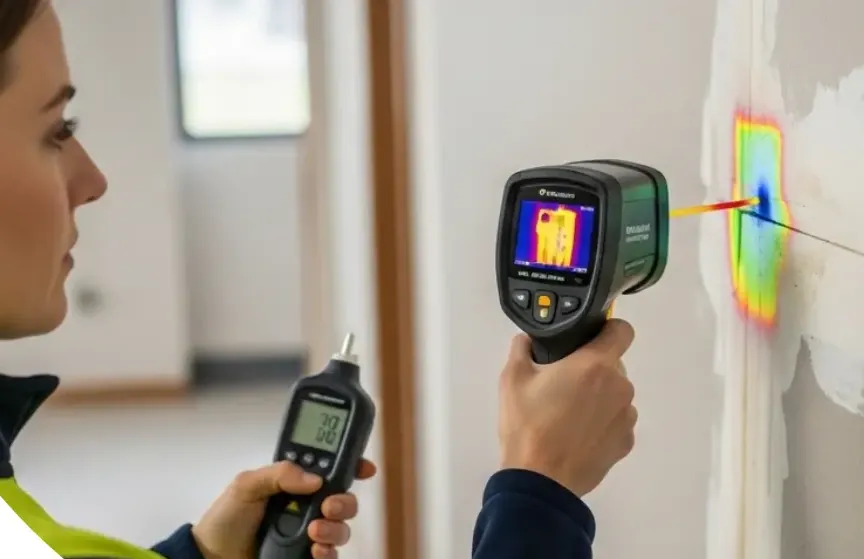
The visual inspection covers the affected rooms and the spaces behind and above them, with a moisture meter and a thermal camera in hand. Where growth is visible, small and clearly caused by something already found, such as a shower with no extraction, the visit is short and the scope is simple, and the point of it does not change: name the water.
Moisture mapping, and why the meter reading is the figure that counts
Moisture mapping means taking readings at fixed points and writing them down, so the same points can be read again later and compared. It is what turns wet to the touch into a number somebody else can check.
Thermal imaging decides where those points go. The camera shows differences across a surface and the meter records the moisture, and it is the meter reading that goes in the report because that is the figure an adjuster can verify.
The S500 standard expects readings at each monitoring point on each day a drying project is active, along with photographs that catch the meter reading and the affected material in the same frame. An inspection is where the first of those readings is taken.
Mold testing: air and surface sampling, and when it is worth paying for
Air and surface samples are collected on site and read by a laboratory. A surface sample shows what is on or in a material; an air sample shows what is airborne in the space at the moment it was taken.
Sampling is worth paying for when the growth is hidden, when a musty smell has no visible cause, when a purchase or a tenancy needs a third party number, or when a previous remediation is in dispute.
It is not a substitute for finding the water. A laboratory result tells you what is present. It does not tell you where it is coming from, and the second question is the one that decides whether the problem returns.
Condition 1, 2 and 3, and what each one means for the scope
The S520 standard sorts a space into three conditions. Condition 1 is a normal indoor fungal ecology and needs no remediation. Condition 2 is settled spores and fragments from a source nearby, cleaned and verified. Condition 3 is actual growth, which is contained and removed.
The condition sets the scope, not the square footage. A small area of condition 3 inside a wall cavity is a bigger job than a large area of condition 2 dust across a basement ceiling.
So the report says which condition was found, where it was found, and where the boundary between conditions sits, because that boundary is where the containment goes.
Buying, selling or renting, when the inspection has a deadline
Property inspections run to a contract date, so the report has to arrive in a form the other side accepts: a named source, the affected materials, the sampling result where sampling was taken, and a scope that can be priced.
Where the same company would also do the remediation, book an independent laboratory clearance in your own name, which is what a buyer's agent or a management company will want to see.
A report with reading positions, figures and a date can be read again three months later and checked against a second visit. A report built on photographs of a stain cannot.
What the inspection does not do
It does not give a medical opinion. Whether a particular symptom is caused by mold is a question for a doctor, and an inspection report that answers it has overstepped what an inspection can see.
It does not certify a property as mold free. No inspection can, because ordinary indoor air carries spores everywhere, which is exactly what condition 1 in S520 describes.
And it does not settle an argument about species. The work that follows visible growth on wet material is set by the condition and by the moisture, and both of those are what the report records.
It does not settle a masonry question either. White powdery staining on brick or block is efflorescence, and it points at water moving through masonry rather than at growth on a wet finish. The inspection says which of the two is on your wall, and where the answer is the masonry, that is a repair rather than a remediation.
After the report
The report is yours. Use it to price the remediation here, to price it elsewhere, or to hand to a landlord who is responsible for the repair.
Where the remediation runs with this team, the scope in the report becomes the scope in the estimate and the verification at the end is checked back against it. Where the water is a plumbing or a roofing repair, that part is named in the report so it does not fall between two contractors.