
Back to Water Damage Restoration

Services

Emergency water damage response, any hour

A person answers at any hour and a technician calls back with an arrival time for your street.

5.0 from 168 Google reviews 24 hours, by appointment

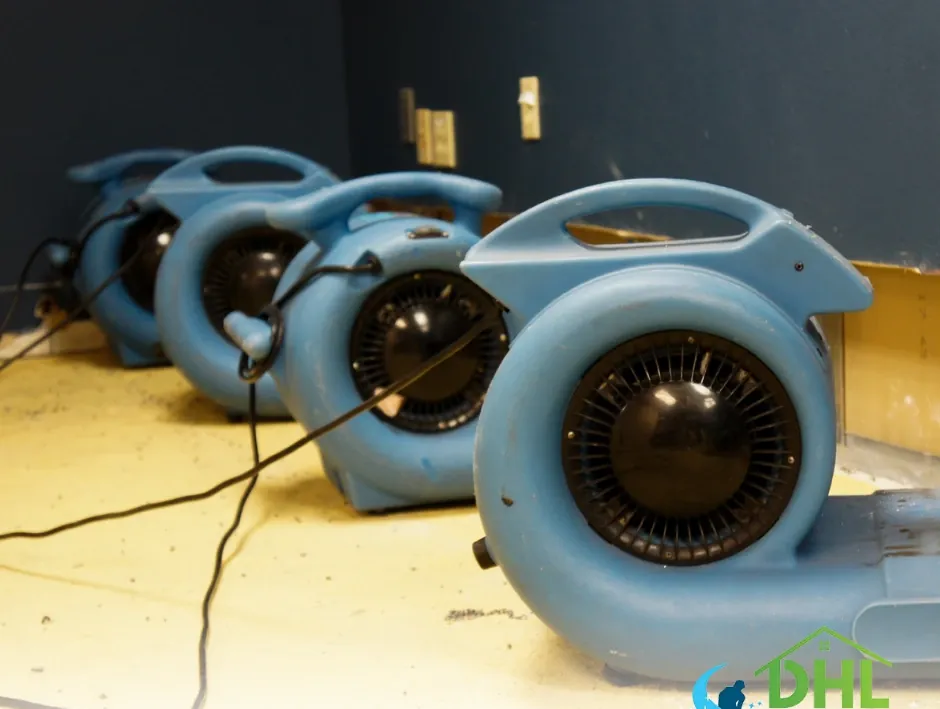
Three blue air movers standing in a row on a damp floor with their power leads running behind them.

reference photograph, not one of our jobs

Photo pending

Sheet 01A, Water Damage Restoration

Scope

What this covers

This is the page for a property that is wet right now. Call first. A person answers at any hour, takes the address and the cause, and a technician is dispatched and calls you back with an arrival time for your street. Everything else on this page is what to do while you wait and what happens when the technician gets there.

  • A person answers the phone at any hour, including nights and weekends
  • A technician is dispatched and calls back with an arrival time for your street
  • Emergency extraction of standing water on the first visit
  • Category and class assessment before any equipment is placed
  • Photographs and a moisture map taken before anything is moved
  • A written estimate before any work begins, written at the property on an emergency call

Detail

The first hour, in order

Five things happen between the call and the first piece of equipment going down, and they happen in this order on every job.

The order matters. An assessment made after the equipment is running is an assessment made on a room that has already changed. Photographs taken after the furniture moved are photographs an adjuster cannot use. Extraction before drying is the rule the whole trade runs on, because a machine that lifts liquid water out of a carpet removes in minutes what a dehumidifier would take days to pull through the air.

24 Hour Emergency Water Damage Response Drawn from the standard. This is a drawing and no reading on it is live. Tide line

Drawn from the standard. This is a drawing and no reading on it is live. Water moves into porous material by capillary action, so the wet area is always larger than the visible one.

Before the technician arrives
You shut the water off at the main, stay clear of standing water near outlets, and photograph every wet room.
On arrival
Source, duration and spread are established, then the category and the class are assigned.
Moisture is mapped with a meter past the visible wet edge, and the readings are written down.
First work
Standing and absorbed water is extracted from carpet, pad and hard floors.
Air movers and dehumidification are placed, and the first reading set closes the day.

Common questions

What people want to know before booking

What happens when I call?

A person answers, takes the address, the cause and how long the water has been there, and gives you the short list of things worth doing before anyone arrives. A technician is dispatched and calls you back with an arrival time for your street. No automated queue and no callback form stands between you and that conversation.

Do you give an arrival window?

The arrival time is given for your address once the technician knows where they are starting from. One number for a six county territory is a number that gets broken at the edge of it, so the time you are given is the one for the drive to your street rather than an average.

Can you start work at two in the morning?

Yes. Emergency extraction runs at any hour, because an hour of standing water at night costs the same material as an hour of standing water at noon.

What does the first visit cost?

You get a written estimate before any work begins, and there are no hidden fees. On an emergency call it is written at the property so the extraction is not held up, because the cheapest hour of a water loss is the first one.

The method

The first thirty minutes, while you wait

Shut the water off at the main if the source is a supply line, an appliance hose or a water heater. Most homes have the main inside near the meter or where the service enters the basement wall, and a quarter turn ball valve stops in one movement. If the source is rain or groundwater there is nothing to shut off and the priority moves to the second item on this list.

Stay out of standing water anywhere near an outlet, a power strip, a cord or the electrical panel, and do not switch anything on or off from inside a flooded room. Water on a floor can reach an outlet, a cord or the panel at the wall, and there is no safe way to judge that from the middle of the room. Wait outside it and tell the technician what the water is touching.

Photograph everything before it moves. Every wet room, every wet surface, the source if you can see it, and the water line on the wall if there is one. This photograph set is the strongest thing in the insurance file, because it is the only record of the loss before anybody worked on it, and no restoration company can create it after the fact.

Then lift what can be lifted. Get handbags, boxes, electronics and books off the floor. Lift the skirt of upholstered furniture onto foam blocks or aluminum foil if you have either. Pull area rugs off wet hard floors, because a wet wool rug on a wood floor bleeds dye into the floor within hours and destroys itself at the same time. Leave heavy furniture where it is.

What the technician does on arrival

The assessment comes first. The technician establishes where the water came from, how long it has been standing, how far it has traveled and what it has touched, then assigns the category and the class under the ANSI/IICRC S500 standard. That pair of numbers governs everything that follows: what is dried in place, what is removed, how much equipment goes into the room and how the file reads.

Moisture is then mapped. A meter is run across the affected area and well past the visible wet edge, because the edge of a wet area is almost never where the carpet looks dark. Readings are taken at fixed points that become the monitoring points for the rest of the job, so the last reading is comparable with the first.

Extraction follows. Standing water goes first, then the absorbed water in the carpet and pad, then the water lying on and in hard flooring. Only after that does drying equipment go down, because air movers over a saturated carpet move water into the air faster than any dehumidifier in the room can take it back out.

The visit ends with the equipment placed, the first reading set logged and a plain explanation of what is being dried, what is coming out and roughly how many days it will take.

Why the arrival time is given per street

Every restoration company in this market publishes an arrival promise and the numbers have converged around an hour. A single number covering a six county territory is a promise that holds in the middle of it and breaks at the edge, and the edge is where the customer is standing in water.

The version used here is a time given for your address, on the callback, once the technician knows where they are starting from. That is a smaller promise and a keepable one. The counties covered are Passaic, Essex, Hudson, Union, Bergen and Morris, and the drive across any two of them at four in the afternoon is not the drive at four in the morning.

A person answers at any hour, a technician is dispatched and calls back with an arrival time for your street.

What runs on the first visit and what waits

Emergency extraction, the assessment, the moisture map, the photographs and the equipment placement all happen on the first visit. Removal of unsalvageable material starts on the first visit where the category requires it, because a category 3 pad left down overnight contaminates a subfloor that would otherwise have survived.

Reconstruction waits. Replacing drywall, re installing carpet, refinishing a floor and repainting all happen after the structure reads dry, and doing any of them earlier seals water into an assembly. That work is covered on the restoration page.

The source repair also waits on the trade that owns it. Plumbing, roofing and electrical repairs are not performed here. Where the source has not been stopped, drying is postponed rather than started, because a building still taking on water cannot be dried.

Before you call

Frequently asked questions

Question 1: Is there really a person answering at three in the morning?

Yes. A person answers at any hour, by appointment. Water damage is the primary business here, which is why the phone is answered rather than routed to a message.

Question 2: How quickly do I need to act?

Within hours rather than days. The EPA guidance is that water damaged areas and items should be dried within 24 to 48 hours to prevent mold growth. Inside that window most materials are dried and saved. Past it, more of the material stops being dryable and starts being removable.

Question 3: Should I turn the heat or the air conditioning on?

Leave the system off until the technician has looked at it, particularly if water reached a floor register, an air handler or ductwork in a basement. Running an air handler that took water moves moisture and contamination through the whole house, and it is one of the routes a contained water loss becomes a whole building problem.

Question 4: Can I start pulling up the carpet myself?

Photograph it first, and then only if the water is clean. Pulling carpet in a category 2 or category 3 loss without protective equipment exposes you to what is in the water, and lifting carpet badly delaminates the backing and turns a carpet that would have been dried into a carpet that has to be replaced.

Question 5: Do you charge to come out and look?

The estimate is free and it is written before any work begins. Where the property is actively wet the visit is an emergency response, the estimate is written at the property, and it covers the extraction, the drying and any removal that follows.

Customer reviews

5.0 from 168 Google reviews, opens in a new tab
“DHL Carpet & Water Damage Restoration saved the day! They responded quickly to my emergency, were professional and courteous, and their work was top-notch.”
Priscila Agrusa · · 5 stars on Google,

“I was impressed by DHL's prompt service and expertise. They efficiently handled my water damage issue, and the results were excellent. Great communication throughout the process!”

Viviana Gil · ·

“We had an unexpected shower leak due to an incorrect installation by the previous owners. The team arrived the SAME DAY to diagnose the issue, and within 24 hours, the repair crew was on-site to resolve the problem.”

Kaiden Braxton · ·

Read them all on Google, opens in a new tab

Coverage

Where we do this

We cover six counties across North and Central New Jersey. All services are performed at your home or business.

Towns we cover

Estimate request

Tell us what needs cleaning

Tell us the rooms, the surfaces and the address, and attach a photograph of the affected area if you have one. You receive a written estimate before any work begins, with no obligation.

Written estimate, no obligation Answered any hour at (908) 520-8698 5.0 from 168 Google reviews EPA-registered products, safe for pets and children

Written estimate

NO. 0168
A written estimate before any work begins, with no obligation.
Please enter your name.
Enter a 10 digit phone number.
Enter a valid email, or leave it empty.
Enter the street address.
Enter the town.
Enter the 5 digit ZIP.
What needs cleaning? (pick at least one)
Pick at least one surface.
Photographs of the area (optional, up to 5, 8 MB each)

A photograph of the area helps us give an accurate estimate.

    The estimate is free and there is no obligation.

    NORTH JERSEY · N.J. ESTIMATE · IN WRITING RECEIVED NO. 0168

    Request received.

    Your written estimate comes back from the technicians who do the work. For anything urgent, call (908) 520-8698.

    Get my estimate