Back to Chimney Repair

Services

Chimney masonry repair and tuckpointing

Open joints raked out and repointed, spalled brick cut out and replaced.

5.0 from 168 Google reviews 24 hours, by appointment

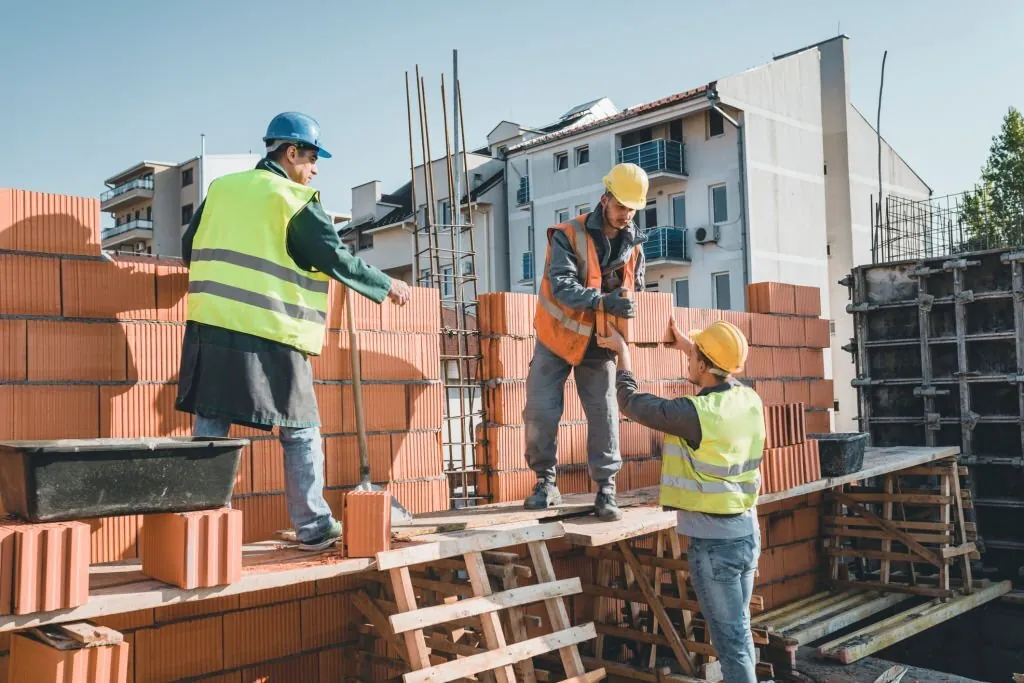
Two masons laying clay blocks on a scaffold at a building site, mortar and a pallet of block beside them.

reference photograph, not one of our jobs

Chimney masonry and tuckpointing

Sheet 03F, Chimney Repair

Scope

What this covers

Mortar fails before brick does, and it is meant to. A chimney is repointed when the joints have eroded, opened or cracked far enough to let water into the wall, and the work is to rake the failed mortar back to sound material and fill the joint again. Where the brick faces themselves have blown off, those units are cut out and replaced, because a spalled face has no weather surface left and will keep taking water in.

  • Assessment of how deep the mortar has failed and how far up the stack it runs
  • Failed joints raked back to sound mortar, never skimmed over
  • Repointing with a mortar matched to the existing brick and joint profile
  • Spalled and cracked brick units cut out and replaced
  • The top courses and the crown checked, since they take the most water
  • The findings and the extent written down before the work is priced

Detail

How masonry fails on a chimney

Every one of these has water behind it. A chimney stands clear of the roof, wet on four sides and with nothing above it but a crown.

Chimney Masonry and Tuckpointing Drawn from the standard. This is a drawing and no reading on it is live.

Drawn from the standard. This is a drawing and no reading on it is live. The United States National Park Service states that water wicks into brick cores and, in a northern climate where winter freezes are prevalent, makes the brick deteriorate from freeze thaw action.

Eroded joints
Mortar washed and weathered back behind the brick face. The joint no longer sheds water and starts taking it in. Raked and repointed.
Spalling
The face of a brick pushed off from behind, usually by water freezing inside the unit. Once the face is gone the brick absorbs faster, so it accelerates. Those units are cut out and replaced.
Cracking through courses
A crack running vertically through brick and mortar together is movement and not weathering, so it is written up as a structural finding.

Common questions

What people want to know before booking

How do I know it needs repointing?

Look at the joints from as close as you can safely get. Mortar that has receded behind the brick face, joints you can push a key into, sand collecting on the roof below the stack, or vertical cracks running through several courses. Any of those means water is getting into the wall, and how far it runs is what an inspection establishes.

What is the difference between repointing and tuckpointing?

In practice the two words are used interchangeably for the same job: removing failed mortar and refilling the joint. Strictly, tuckpointing is a finishing technique using two mortar colors to give the appearance of fine joints. When a quote says tuckpointing on a chimney it usually means repointing, so confirm which one it covers.

Can you just repoint the bad joints?

Sometimes, and sometimes patching a face is worse than leaving it. Mortar fails from the top down and from the weather face inward, so a stack with three bad courses at the top usually has more behind them. The report says how far the failure runs and where a partial repoint stops.

At what point is repointing no longer the answer?

When the units themselves have failed and not the joints, when a stack is leaning or has moved out of plane, or when so much of the brick face has spalled that replacing it is most of a rebuild anyway. That is the point where the answer is a partial rebuild above the roofline rather than more pointing.

The method

Why mortar goes first

Mortar is deliberately the weaker material in a wall. It takes the movement, the salt and the freeze and thaw so the brick does not, and it is meant to be replaced periodically over the life of a structure. On a chimney that cycle runs faster than anywhere else on the house, because a stack is exposed on four faces, has no eave over it, and takes wind driven rain that a wall under a roof overhang never sees.

Freeze and thaw, the mechanism behind the damage

The United States National Park Service, writing about common problems with brick masonry, names water as the most destructive force on historic masonry surfaces and states that it wicks into the brick cores, so that in a northern climate where winter freezes are prevalent the brick deteriorates from freeze thaw action. That is chimney decay in this climate. Water gets in during the fall storm season, freezes through the winter and pushes the material apart from inside, so the damage becomes visible in late winter and spring rather than during the rain that caused it.

Matching the mortar matters

New mortar that is harder than the brick around it does not protect the wall, it damages it: the movement and the salts that the old mortar used to absorb get taken by the brick faces instead, and the spalling gets worse after the repair instead of better. Older chimneys were built with softer mortars than a modern bagged mix, so the mix is matched to what is there, along with the joint profile, so a repointed section is not a stripe of gray across a hundred year old stack.

Raked, not skimmed

A repoint that goes wrong usually goes wrong here. Smearing fresh mortar over a failed joint bonds it to loose material, and it comes away in sheets, taking more of the joint with it. The joint is cut back to sound mortar to a depth that gives the new material something to key into, the dust is cleaned out, and the joint is filled and finished to the original profile. It is slower, and it is the difference between a repair that holds and one that fails at the next freeze.

Repointing and waterproofing are a sequence

A water repellent applied over open joints seals the water in instead of out, so the order is repoint first and waterproof afterwards, once the masonry is sound and dry. Doing it the other way round is one of the more expensive mistakes available on a chimney, because the repellent has to weather off before the joints can be repaired properly.

When this work is done

Late winter into spring, after freeze and thaw has opened what the fall filled, and before the next storm season. That is when spalled brick and white staining become visible, and it is the reason masonry work sits in the spring calendar here rather than beside the fall sweeping season.

Before you call

Frequently asked questions

Question 1: What causes chimney bricks to crumble?

Water and frost. The National Park Service states that water wicks into brick cores and, in a northern climate where winter freezes are prevalent, makes the brick deteriorate from freeze thaw action. On a chimney the usual source of that water is a failed crown or open joints above the damage.

Question 2: What is the difference between repointing and tuckpointing?

For chimney work they are used to mean the same thing: raking out failed mortar and refilling the joints. Strictly, tuckpointing is a decorative technique using two mortar colors to imitate fine joints. If a quote says tuckpointing, ask which of the two it is pricing.

Question 3: Can spalled brick be repaired?

The face cannot be put back. A unit whose face has blown off has no weather surface left and absorbs water faster than a sound one, so those units are cut out and replaced. Coating over spalled brick hides it for a season and traps the water that caused it.

Question 4: How much does chimney repointing cost?

No price band is published here, because the cost is set by how far up the stack the failure runs and by the access needed to reach it. The extent is established from the inspection and a free written estimate follows it, listing what is being repointed and what is being replaced.

Question 5: Should I waterproof the chimney after repointing?

Yes, and in that order. A breathable repellent applied to sound, dry masonry keeps wind driven rain out while letting the wall dry. Applied over open joints it seals moisture inside the wall instead, which is why the pointing is done first.

Customer reviews

5.0 from 168 Google reviews, opens in a new tab
“Water damage is stressful, but DHL made the restoration process smooth and easy. Fast, reliable, and professional service. Highly recommend!”
Veronica Hernandez · · 5 stars on Google,

“I called for advice on a water issue. The technician was helpful, answered all my questions, and even offered to assist further if needed. I'll definitely recommend them to anyone seeking honest and reliable help.”

Juan Kingston · ·

“Excellent job with the mold remediation in our building basement storage & conference room. They completed the work quickly after discovering mold on the wall. Their work was thoroughly done and their pricing was very fair.”

Maria Edmond · ·

Read them all on Google, opens in a new tab

Coverage

Where we do this

We cover six counties across North and Central New Jersey. All services are performed at your home or business.

Towns we cover

Estimate request

Tell us what needs cleaning

Tell us the rooms, the surfaces and the address, and attach a photograph of the affected area if you have one. You receive a written estimate before any work begins, with no obligation.

Written estimate, no obligation Answered any hour at (908) 520-8698 5.0 from 168 Google reviews EPA-registered products, safe for pets and children

Written estimate

NO. 0168
A written estimate before any work begins, with no obligation.
Please enter your name.
Enter a 10 digit phone number.
Enter a valid email, or leave it empty.
Enter the street address.
Enter the town.
Enter the 5 digit ZIP.
What needs cleaning? (pick at least one)
Pick at least one surface.
Photographs of the area (optional, up to 5, 8 MB each)

A photograph of the area helps us give an accurate estimate.

    The estimate is free and there is no obligation.

    NORTH JERSEY · N.J. ESTIMATE · IN WRITING RECEIVED NO. 0168

    Request received.

    Your written estimate comes back from the technicians who do the work. For anything urgent, call (908) 520-8698.

    Get my estimate